
A note from our president, András Tóth (associate professor at Károli University in Budapest)
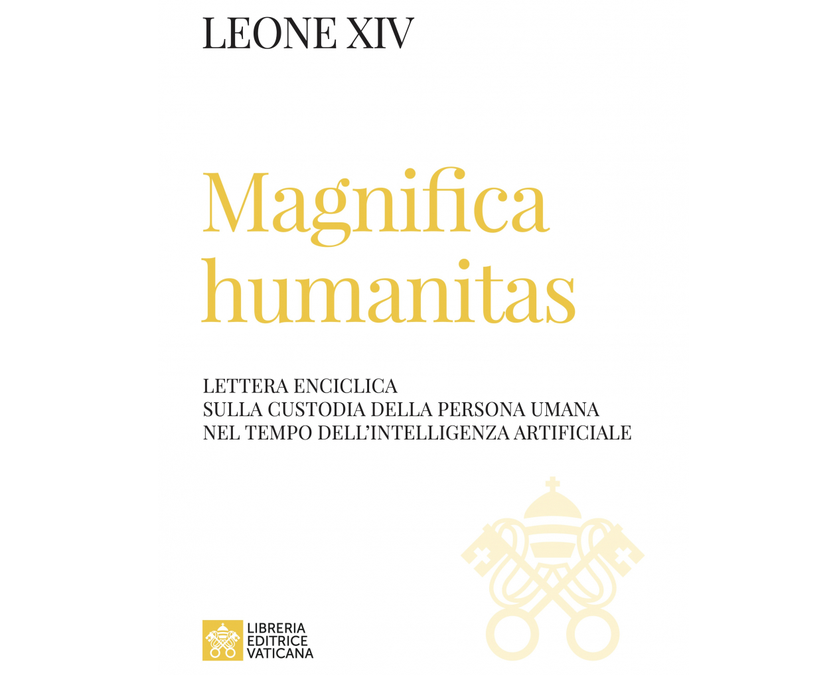
Since Pope Leo’s first encyclical, Magnifica Humanitas, reflects on the challenges posed by Artificial intelligence (AI) through the lens of Catholic social teaching (CST), it is no coincidence that it also contains observations from a competition perspective. CST has, in fact, traditionally addressed competition and its regulation.
According to Pope Pius XI’s encyclical Quadragesimo Anno (88.): “[…] the right ordering of economic life cannot be left to a free competition of forces. […] Destroying through forgetfulness or ignorance the social and moral character of economic life, it held that economic life must be considered and treated as altogether free from and independent of public authority, because in the market, i.e., in the free struggle of competitors, it would have a principle of self direction which governs it much more perfectly than would the intervention of any created intellect. But free competition, while justified and certainly useful provided it is kept within certain limits, clearly cannot direct economic life […]” In light of this, Magnifica Humanitas – reflecting on the ideas expressed by Adam Smith in his book The Wealth of Nations, which marks its 250th anniversary this year – states that “it is no longer possible to rely solely on the “invisible hand” of the market” (163.) In this respect, Pope Leo’s encyclical also reflects on Pope Francis’s Apostolic Exhortation Evangelii Gaudium, which states: „We can no longer trust in the unseen forces and the invisible hand of the market. (…) the economy can no longer turn to remedies that are a new poison, such as attempting to increase profits by reducing the work force and thereby adding to the ranks of the excluded.” (204.)
Magnifica Humanitas continues the tradition established by the papal documents on CST and applies it to AI. On the one hand, it emphasizes that competition serves the common good only within a regulated framework: “Politics has the task of orientating economies and technologies to the common good, promoting dignified work, social inclusion and an equitable distribution of the benefits of innovation.” (163.) On the other hand, the pope also exposes the pursuit of profit in the context of AI (i.e. “idolatry of profit.” 10.): „a technocratic and post-humanist mentality that tends to regard the human person as an object to be manipulated or a resource to be optimized, removing all safeguards against the unchecked pursuit of profit.” (172.)
Alongside Adam Smith’s 250-year-old “invisible hand,” the encyclical introduces the concept of “invisible infrastructure”: those who control AI may embed their own moral frameworks into these systems (107.)
Rerum Novarum inaugurated the modern tradition of CST and anticipated several principles that would be articulated and developed more fully in later encyclicals. Among these were the universal destination of goods, understood in continuity with earlier Thomistic teaching, and the dignity of work. Magnifica Humanitas also emphasizes that the modern “goods” intended to benefit everyone must now include patents, algorithms, digital platforms, technological infrastructure, and data. (67.) When these resources are controlled by only a few, without fair access or sharing, they create inequality and contradict the universal destination of goods by deepening the divide between those who can benefit from the digital revolution and those who are left behind. (67.)
According to the encyclical, data have become the new “rare earths” of power. (178.) Those who control data possess structural leverage over the future because they can shape needs, markets, and possibilities. In this sense, the digital age risks becoming colonialism in another form. (178.) The encyclical identifies one of the „most urgent moral challenges of our time: to ensure that shared knowledge becomes a true common good rather than an instrument of dominance.” (178.) The digital economy must therefore become more transparent, ensuring that no competitive advantage is established on the basis of hidden exploitation. (179.) The encyclical specifically identifies one form of this exploitation: „the subtler forms of addiction linked to the “digital attention economy” should not be underestimated since platforms and services are often designed to capture users’ time and attention, exploiting their vulnerabilities and weakening their inner freedom.” (170.)
As with every major technological transformation, AI tends to reinforce the power of those who already possess economic resources, technical expertise, and privileged access to data. (108.) The encyclical also discusses “disarming,” which involves challenging the idea that „technical power automatically confers the right to govern. It does not reject technology but calls for preventing technology from controlling humanity and freeing it from monopolistic control.” (110.) Technical power, when unchecked, does not empower us; instead, it leaves us more isolated and vulnerable to domination. (113.)
The encyclical specifically highlights the issue of market dominance in the context of AI. It addresses the shift from “Big Tech” to “Big AI,” as well as the unequal distribution of data and technologies, which are concentrated in the hands of a few.