
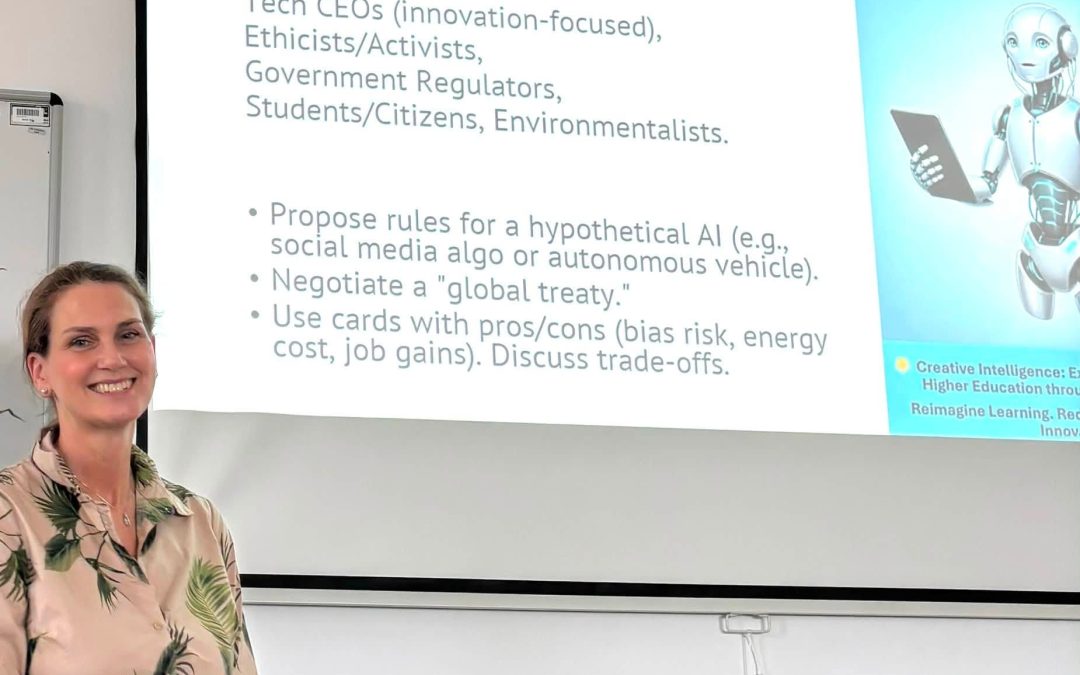
An international summer university on artificial intelligence (AI) and higher education was held between 6 and 12 July in Budapest, organised by the Artificial Intelligence and the Human Research Group of the Faculty of Humanities and Social Sciences at Pázmány Péter Catholic University (PPCU). Our association member Ágnes Tahyné Kovács participated as a speaker.
In her presentation entitled Balancing Innovation and Integrity: Ethical Challenges in Regulating AI for a Sustainable Future, she systematically examined the natural and social impacts of AI applications, with a particular focus on environmental effects. She emphasised that when examining the ethical questions of AI, we must not overlook the background provided by the natural environment to the rapidly advancing technical development. The ecological footprint of the technology can be examined through two lenses: hardware and software. Although there are efforts to reduce the environmental footprint, the lack of data and the complexity of the processes make this difficult. The explosive spread of the technology requires a redesign of the use of natural resources. We are in the final hour of the ecological conversion proclaimed by Pope Francis. The presentation pointed out that one of the greatest challenges facing people today is the realisation that the purpose of human existence cannot be earthly usefulness; respect for creatures and the preservation and responsible use of natural resources must become part of our identity.